A Bee in the City

adventures in an urban garden

Help! The runner beans have staged a coup! 19 August 2009

They have taken over the front garden!

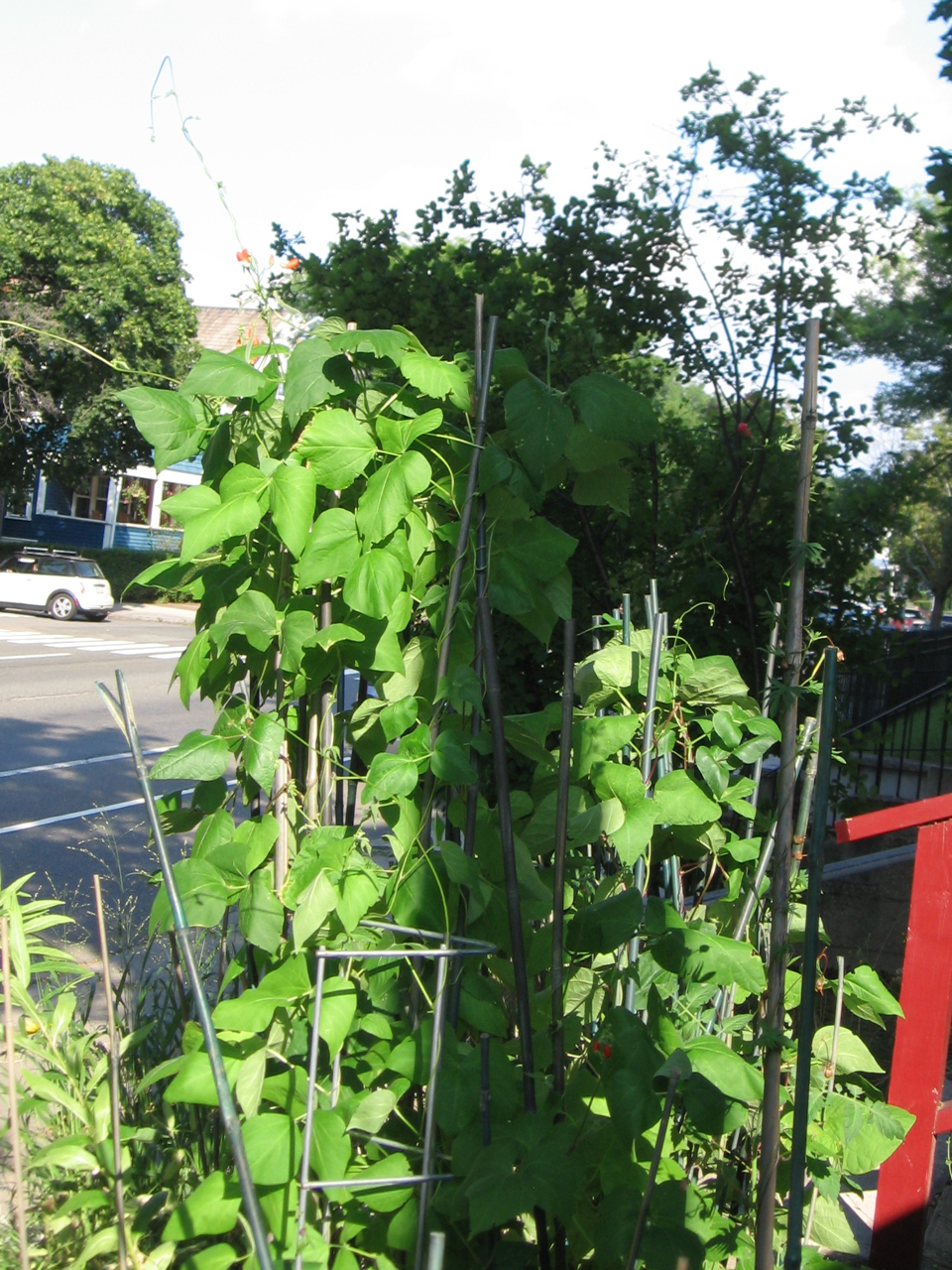
Runner beans compared to the shrub (in background) - they're about the same size!

Runner beans compared to the shrub (in background) - they're about the same size!

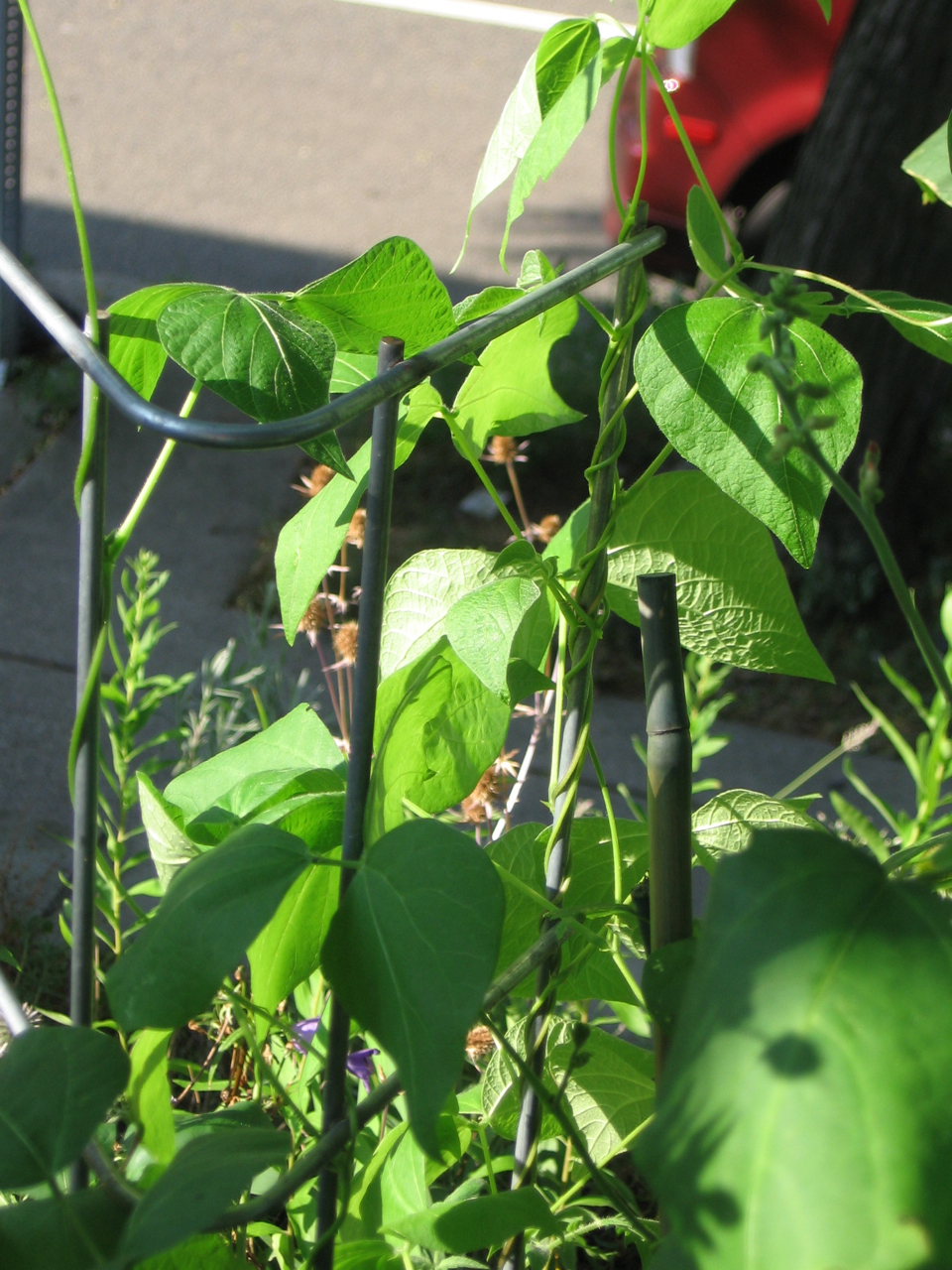
As you may have noticed in the above photo, the runner beans have even taken over a tomato trellis!

As you may have noticed in the previous photo, the runner beans have even taken over a tomato trellis!

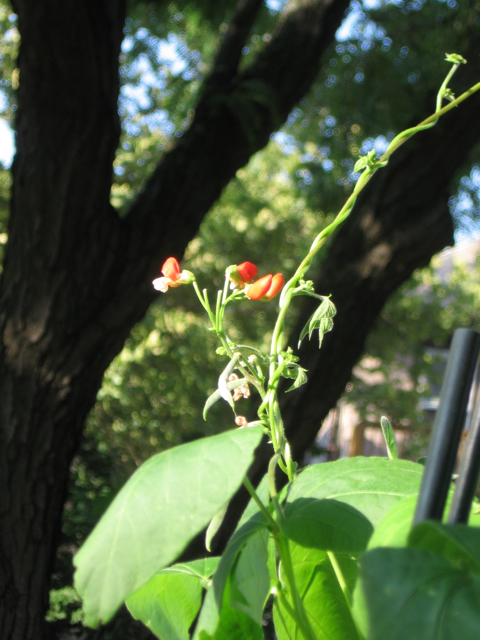
blooms and a baby bean on runner bean 'Painted Lady'

blooms and a baby bean on runner bean 'Painted Lady'

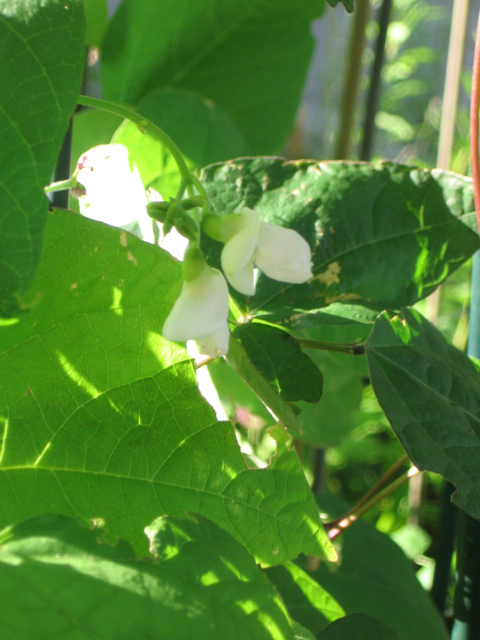
A third runner bean has joined the bloomfest, this one known as 'Potato Bean.'  Some people say Potato Bean is synonymous with 'Aztec Half Runner' but at least for my source, this is not true, as Potato Bean is much taller.  Its flowers are just as large as Scarlet Runner and its cultivar 'Painted Lady,' though as you can see, being white, they are not quite as stunning to behold to most people.

A third runner bean has joined the bloomfest, this one known as 'Potato Bean.' Some people say Potato Bean is synonymous with 'Aztec Half Runner' but at least for my source, this is not true, as Potato Bean is much taller. Its flowers are just as large as Scarlet Runner and its cultivar 'Painted Lady,' though as you can see, being white, they are not quite as stunning to behold to most people.


Still here 8 August 2009

Cup Plant blooms, sunlit on 27 July

Cup Plant blooms, sunlit on 27 July

I’m still here.  As those of you that personally know me already know, personal issues have kept me busy of late.  Today was the first day in a while that I got to spend much time in the garden.  The nursery lost so much business in our extremely cold, rainy June that they’ve already brought out their “buy one get one free” sale on all but the largest perennials, so I recently bought some more plants there, and today I planted most of them.  One was the relatively new echinacea, ‘Fragrant Angel,’ which is a creamy color somewhere between soft cream and lemon yellow, and while it is a bit fragrant, it is not as fragrant as its name might lead you to believe.  (Here is one of many pages about it on the web, which also notes the lack of strong fragrance, which many gardeners find important to note as many catalogs make it sound like it’s ridiculously fragrant.)  It was originally quite expensive, about twice the price of their regular perennials (maybe even a bit more), but I got it at regular perennial price in their sale, which quite pleased me, and to be honest, was the biggest reason I bought it instead of buying one of the other echinaceas in the sale.  Though I did also like its off-white color to provide some contrast to my three pure white echinaceas.  Even though I didn’t have any more space near them after planting the several more smaller-potted echinaceas I already got earlier this summer, and thus it is off by itself, though with its more daisy-like appearance than other echinaceas’ lowered petals (also noted at the link), perhaps it is best it’s closer to the shasta daisy than to the rest of its clan.

Anyhow, I also planted another hyssop (much larger in size than the three already in the garden, and blooming, unlike them), two more perennial salvias (Salvia nemerosa to be specific; ‘Blue Hill’ and a deep rose one which is a nice complement to all the mauve and pale pink flowers in the garden, as I have a tendency to pick those latter two shades of pink), another agastache, another rock cress, another pineapple sage, and…I think something else.  I also transplanted a mountain mint and the lemon verbena.  It’s been so windy this summer that the tall plants near the ‘wind tunnel’ are pretty much permanently on severe tilt (some at ninety degree angles or more!), and thus are shading the lemon verbena more than it otherwise would have been, so I hope its new home is sunnier.   I also finally FINALLY planted the poor front-garden dahlias (3 ‘Winsome,’ which is probably my favorite glad, as well as 1 each of ‘Thomas Edison,’ ‘Juanita,’ ‘Prince Noir,’ ‘Jersey’s Beauty,’ and ‘Kidd’s Climax,’ all from Old House Gardens)  – all of them are more heat-tolerant than most dahlias, which typically prefer the warm-but-not-hot days and cool nights of their originating land), and at the bottom of the box I’d been storing them in, discovered a gladiola that had been unwittingly buried beneath them (‘Atom,’ also from OHG, as are my other glads) and so planted it with the other short glads.  The glads have been growing quite vigorously in the warmer weather and the sporadic deep rains and with the manure mulch, but they haven’t budded yet.  Many other gardens have blooming glads now, though, although I imagine they planted theirs before I did.  I see more gardens with glads every year here and I am happy to see them coming somewhat back into fashion after decades out of style in gardens.  I also see the gorgeous huge blooms for sale at the farmers’ market every year now, which makes me happy too.   Anyway, I then used the last of the manure to mulch the dahlias and glad ‘Atom.’  I’ve still got the rest of the dahlias to plant in the back garden, which is often 10 degrees F colder (sometimes more) than the front garden on summer days.

In addition to ‘Atom,’ the glads I’m growing are:  ‘Apricot Lustre,’ ‘Bibi,’ ‘Elvira,’ ‘Fidelio,’ ‘Friendship,’ ‘Lucky Star,’ ‘Melodie,’ ‘Spic and Span,’ ‘Violet Queen,’ and ‘White Friendship’ (the last one isn’t on OHG’s website any more, but I suppose the name is pretty self-explanatory – it’s a white version of ‘Friendship’).  That sounds like a lot, but like with the dahlias, with several of them, I only planted one corm.  Also like the dahlias, I planted them in clumps with two to four types in each clump.  (I also tend to do this with hardy bulbs, though in those cases, they aren’t always the same species.)  I base my clumpings loosely on color, height/size, and bloom time.

One of my mums and one of my asters are already blooming, as has been common in other gardens in recent weeks.  I don’t know if it was the gloomy weather or the cold weather, or a combination of both, that triggered their early bloom.  (Some people posit that it’s short day length that triggers the fall-blooming flowers; others posit that it’s colder temperatures.  As far as I know, nobody has yet proven which is true, or whether for some plants it is a combination of both.)  Both of my blooming ones typically bloom in September here, sometimes into October, and some asters start blooming in October.  I’ve noted that most of my other asters and some of my other mums, as well as some of my goldenrods, are also already budded up.  In some gardens literally all of the mums or asters are already blooming; in many cases they began by mid-July.  It is odd to see so many of them blooming now here, and I find it sad that the autumn flower display, normally so gorgeous here in New England, will be somewhat less than normal.

My scarlet runner beans have grown rampantly this summer – many of the vines are eight feet now – and then this week they abruptly finally started to bloom.  So far the species (Scarlet Runner Bean) and cultivar ‘Painted Lady’ are blooming.  I suppose it is not surprising to hear that scarlet runner bean has scarlet flowers.  ‘Painted Lady’ has flowers that are half a bit of a softer red and half white.  They are climbing tall poles together (though not tall enough for them, but really, who would want to get out a ladder and harvest beans at nine feet anyway?) and look quite pretty blooming together.  My other runner beans are not as rampant (though in fairness, they are not supposed to be) though they have been growing strongly as well; they have yet to bloom.  Many of my other beans (garden beans, not runner beans) are blooming now as well; the purple ones are still blooming in shades of purple, and have been joined by other bean flowers in shades of yellow, white, and cream.   The peas died in the heat wave we recently had, but astonishingly to me, some of the fava/broad beans survived and have begun putting out new flowers now that it is comparably cooler (mid-70s today, but low 80s in recent days) and sunny again.  This is by far the longest they have ever lived for me in this climate.  My tomatoes have grown a lot (finally!) but still haven’t flowered.  The cucumber dropped its second cucumber as well, but has two more cucumbers forming (they formed before it dropped the second one).  As I’ve mentioned before, I’ve never grown a cucumber before.  It seems to dislike wildly inconsistent temperatures/weather.  Unfortunately we’ve had those a lot here this year.  Probably more than usual.  A high of 60 F was not uncommon for us earlier this summer, though that would have been quite uncommon in past years!


Always only the promise of rain 17 July 2009

Filed under: gardening — beeinthecity @ 3:20 pm
Tags: , , , ,

It was supposed to pour yesterday but once again it didn’t rain at all.  (It last rained on Saturday night, nearly a week ago, and since then the wind – which is especially vicious to the front garden – has been searing most days, which stresses the plants, makes them lose water faster, AND makes the soil itself lose water faster on top of the plants sucking more water out of it than normal.  I noted that by this afternoon, the dirt path that winds behind the front garden bed had begun to crack due to loss of moisture.)  Today I finally gave the full garden a deep watering – no select watering with a watering can.  It always feels like a small defeat when I have to water the full front garden, which has been painstakingly plotted to be as xeric as possible, with the highest-water-preferring plants placed as close to the main crop patch (which by its nature needs more water than the rest) as possible, so that I can just hand-water them all together.  But going out to check on the front garden about five hours after watering, it was amazing the marked improvement in the health and vigor of the plants, though I’m sure that lessening humidity, sporadically sunny skies (rather than constant sun), and a wind shifting to be more and more from the south (which affects many fewer of the front garden’s plants than a breeze with some west, north, or east in it does) aren’t hurting either.

Yet more bean plants are up, and there are ever more beans forming on the plants that are already flowering.  Much to my surprise, some of the peas are still flowering despite temperatures in the upper 80s at the present hour, though I imagine at this high a temperature the flowers will just drop off without pod-set.  I’m noting that ‘Golden Sweet’ pod formation is different when temperatures get this high, and it’s something I’ll need to keep in mind.  The peas start to form in the pods when they are significantly smaller than their size at lower temperatures, from 1/4 to 1/3 smaller, and the peas also seem to form much more rapidly on this cultivar at this temperature.  A handful of the pea plants appear to be just a hair’s breadth from fully dead now (shrivelled leaves, with the stems still green), while others seem to be dying and still others appear to still be in fine health.  All the fava/broad bean plants still seem to be doing fine. The tomatoes are growing much more vigorously, but still haven’t flowered.  (It’s not just me; at the farmers’ market this week, the only tomatoes were ones grown in a greenhouse, and when I walk by other gardens that have flowering tomato plants, the unripe fruit seem nearly the same size from day to day.)  The cucumber looks like it’s going to drop its first little cucumber (which has begun to yellow despite not being full sized), but I noted that another one is now growing on the other vine.

The first cardinal climber to bloom is now flowering prolifically.  The nasturtiums are growing rapidly from seedlings to true plants.  The love-in-a-mist (Nigella) has finally been blooming this week, but so far this year all I’ve seen are white flowers!  (As usual, in early spring I seeded in a mix of cultivars that consisted of white blooms, rose blooms, and varied shades of blue blooms.)  The gladiolas are continuing to grow vigorously, appearing to absolutely adore their aged horse manure and wood chip mulch.

The bird bath was so popular on this dry-earth, damp-air, sun-drenched morning that by the time I watered the front garden and walked back to turn off the faucet, it had already been used, and by the time I went back outside to check on it less than two hours later, it was dirty and half-empty.  The Robins that so often come to the back garden appear to be guiding their second batch of fledglings, one of whom appeared to be sitting on fallen branches holding down the little pile of leaves at the edge of the back garden earlier this afternoon.  I’ve also been hearing the Cardinals and Chickadees a lot today (and possibly the Downy Woodpeckers too, as from inside their call sounds quite similar to Cardinals), and while I was watering saw a brief appearance from a Cardinal that looked to also be from one of this year’s broods.

I saw a really nifty looking probably-wasp first in the back garden and then in the front, appearing to be diligently searching for … something – but I couldn’t tell what that was.  The most distinctive thing about it was a pair of bright yellow-ish antennae that stood out especially markedly against its seemingly black body.  I came in and plugged in the basic info to Google and the most common wasps that fit that seem to be in Europe and Australia, but I came up with a candidate that could be the right one, one of the species of Spider Wasp (Entypus unifasciatus).  If it really is that wasp, it would explain what it was so carefully looking for – a large spider to make up its next meal.  My old garden had several quite large spiders, but in my current garden, the biggest one I’ve seen is about an inch across, and that’s including the leg width.  Perhaps that is why it appeared to be giving up the search right as I was coming back inside.

Still working on that photo post; sorry it’s taking so long.

P.S.  Edited to add: I forgot to mention that the squirrels appear to have eaten – or at least absconded with – most of the rain lilies I potted in that handmade Mexican pot.  I have no idea why it didn’t occur to me that they might root around in the pot despite the bushiness of the sweet violets appearing to cover the entire pot (I’d been counting on the visual appearance of the planting to deter them).  Ah well, live and learn.


Still here! : Another garden update 15 July 2009

Filed under: gardening — beeinthecity @ 2:52 pm
Tags: , , , ,

Hello everyone, I managed to bruise my thumb joint last weekend and had to take a couple days off of both typing and working in the garden.   Before doing so, I happily put down some aged horse manure that I got in a trade with another gardener.  Though I didn’t realize it at the time of the trade (as it was in a non-opaque bag, and the gardener didn’t mention it), it has been mixed with thin sawdust-like wood chips, so it is easier to handle than straight-up manure and forms a nice mulch-like substance.  I added it to most of the crops and to the highbush blueberry bushes and the gladiolas (which I had finished planting; I can’t remember if I’d already finished planting them the last time I mentioned them or not).  It seems to have especially helped the glads, which are sprouting much more vigorously now.  I still have some in the bag, and am planning to add it to the dahlias when I finally plant them (hopefully later today). More recently, I’ve cut down some saplings that had sprouted unbidden in an area where there’s no official garden (one of them was about 15 feet tall!), and have planted some perennials I got in the nursery’s annual 50% off sale of all small-potted perennials they had yet to sell (which seems to be occurring earlier than usual this year, perhaps fitting in with what seems to be a general trend towards only selling larger pots over the summer).  I got eight and planted five of them earlier this week, the last three still waiting.  The ones I planted were one of three sea thrifts, as well as another hen and chicks, a second nodding onion (see below for more on them), a perennial baby’s breath, and … something else.  In addition to the two further sea thrifts, a Sedum album (that is huge, at least twice the size of its pot) is waiting to be planted.

I also got a surprisingly big pot of Egyptian onion AKA walking onion in another trade with a local gardener, and planted some of those in the front  garden before my thumb injury, but have the rest in the pot in back waiting to be planted there.  Generally alliums that propogate themselves vegetatively are the best candidates for partial shade, from what I’ve read.  Oh, I think I haven’t updated since I finished planting the beans either – so, yeah, I also did that.  [I should post a list of the beans I've planted.  So far, I've been too disorganized.]  I spread the aged manure over the bed after finishing planting them.  They’ve reacted quite well to that and also the string of warm, generally sunny days we’ve had since, and I noted this morning that a large percentage have sprouted.  This morning I harvested my first two snap beans (‘Yellow Arikara,’ one bean of which had a small, circular hole partway through it, but no other damage – I’ve never seen the small circular hole on a bean in my garden before, and am curious as to what could have caused it), two peas (‘Golden Sweet’), and four more fava/broad beans (mix of cultivars).  The fava beans are through at the farmers’ market, so my own garden is now my only supply for the remainder of the growing season.

I noted this morning that the purple-podded beans, which have been flowering for a couple of weeks, on and off, are now rapidly forming pods with the nice (to a bean) weather we’ve been having.  The scarlet runner beans are still growing prolifically, but have yet to flower.  There is one little cucumber that has been growing for over a week, and the cucumber plant is still flowering daily.   Someone left some grass clippings near the front garden (I don’t know if they did it on purpose or accidentally) this morning, so I used them to mulch the little patch of cowpeas and such, which dries out so, so fast in the windy weather we’ve been having.

In terms of flowers, the cardinal climber is flowering, much much earlier than last year, and the first morning glory has been flowering, the one I got at the nursery, which has the biggest flowers I think I’ve ever seen on a morning glory.  The calla lilies (the ones that have perennialized here, despite their supposedly not being hardy in my climate; to recap for those that have not been reading long, I got them from a gardening friend, and one survived the first winter here, and then when she gave me more I planted them all in the same spot as the one that survived, and then last winter they all not just survived, but appear to have produced three new calla lilies, presumably by offsets) have been flowering for a little bit, and just today the Salvia patens that has also survived two winters in the back garden (despite also not being supposed to do so) put out its first flower.  Last summer it didn’t flower at all (unless it happened while I was on vacation for a week) so it was nice to see its first vivid blue flower when I went out to water the back garden’s pots.

The cup plant abruptly budded up after our next to last downpour, but its buds have yet to open.  The first echinacea bud is starting to bloom now, though, and there are multiple further buds on that plant and my other echinaceas.  The nodding onions (a native allium, Allium cernuum) are budded as well, and much to my shock, one of my asters is also budded!  I have seen mums blooming in other gardens, so my suspicion is that the exceptionally cool temperatures (until recently) have been fooling some autumn-blooming plants into thinking it is, in fact, already autumn.


One more (maybe not actually very) brief garden update 8 July 2009

…and then hopefully a bigger post, say, finally that photo post maybe.  It had been so beautiful here after all the dreary weather that I’ve spent much more time outside enjoying it than indoors typing at my computer!  (Yesterday it was extremely rainy again, but I started this post two days ago.  Today is cloudy and sporadically rainy, though right now it’s just crisp.)

I harvested my first “wild blueberry” (lowbush blueberry – it’s not really wild if it’s in a garden, is it?) this week, and was very excited about it!  I planted a lowbush blueberry at my old garden, but I got something off about the cultural requirements – possibly too much sun, possibly the wrong soil, I don’t know for sure – and it never produced a single berry.   There are very few of them on the one bush, and none on the other one, but given that they were both still in their nursery pots at flowering time and that blueberries often don’t produce berries till the second year or beyond, I am pleased to have any berries at all.  I had never had wild blueberries till my first visit to New England and they’re something that still charms me after all these years living here.  The taste is so different from the “cultivated” blueberries.

Some of the peas look to be yellowing.  Unfortunately they started to do so after I’d already harvested the last peas I think are forming on those plants, so I don’t know as I’ll get to save seeds from those plants.  Others of the pea plants look just fine, though.  ‘Golden Sweet’ is still putting out pods regularly (I’m definitely keeping that one around in future years and future gardens!), and some of the other cultivars are putting out smaller numbers.  The fava/broad bean plants all still look healthy as of now.  Today it is quite cool, in the low 60s with a strong breeze, and it was the same yesterday (plus regular downpours and some thunderstorms), so I’m a bit surprised the peas would pick now to quit, but so it goes.  The beans that are up to flowering size are mostly putting out flowers like mad, and super early bean ‘Yellow Arikara’ still has cute little pods forming on its plants (I haven’t seen it put out any more flowers this week).  It’s interesting that most of the purple-podded beans seem to also have purple stems and flowers that are some shade of purple.  The first scarlet runner bean has reached the top of its five foot pole.  It’ll probably loop around back down another one; that’s what they usually do. The scarlet runner beans haven’t started flowering yet; I don’t know if they’re waiting for a string of sunny days, or…

The peach-leaved bellflower ‘Telham Beauty’ has put out a fresh flush of blooms after all this rain, even though I didn’t deadhead it.  The coral-flowered penstemon is still making the bumblebees go crazy (and still putting out a rather unbelievable amount of flowers and buds), and the gaillardia ‘Tokajer’ is proving quite popular with the smaller native bees. (The latter two plants are new this year.  So far I’ve been quite pleased with both, and the bees don’t seem to mind their tendency to flop over on my windy site [they were both already starting to bloom by the time I planted them, so they didn't have as much of a chance to adjust to the windy site, which perennials often do by not growing as tall as they would under less windy circumstances].)  The cup plant budded up quite abruptly and its big buds look like they will bloom soon.  The sweet alyssum I seeded in myself has finally begun to reach flowering size, and some of the plants have their pretty little white blooms now.  (Still no annual candytuft blooms as far as I’ve seen; typically they start to bloom around the same time.)  The sweet alyssum cultivar that the nursery carried this year smelled like honey, as the white ones seem to always do, but it was a total dud with the bees, who just LOVED last year’s nursery cultivar. So I’m happy to finally have sweet alyssum flowers that they actually like.  (As I’ve posted here before, since sweet alyssum is quite cold-hardy for an annual, I always start out with nursery seedlings and seed in my own sweet alyssum to take over with their blooms as the nursery seedlings get straggly in early summer.)  Elsewhere in the world of direct-seeded annuals:  The nasturtium seedlings (oh, how many there are now! with leaves in so many beautiful colors!) are growing fast with all the rain, and the love-in-a-mist has budded up with it.  The clarkias are still putting out new flowers (though not as many as a week ago), but the annual poppies, corncockle, and baby blue eyes seem to be about through.

Today I planted the two perennials I bought at the nursery on my way home on Monday, a second sea holly – this one with psychedelic lavender-y stems – that I planted near the original (which has been in my garden since my first year here, two years ago), and another anise hyssop.  Sea holly and anise hyssop are two more plants that the bees go crazy for.  Just make sure that you buy hybrids that aren’t sterile.  One reason I like going to nurseries is to see what plants the bees are attracted to – both to find new plants they like, and to see which cultivars are most popular of plants with numerous cultivars.  With the perennial salvias, for example, there are some cultivars they definitely prefer to others.

That was a small bit of planting (though they were in big pots so it took a while to dig the holes!), but since I last updated, I’ve done heaps of other work in the garden.  I’ve transplanted some things that seemed unhappy or that I just thought could be happier elsewhere, and I’ve planted a lot.  I planted the rest of the tender(-here) salvias and agastaches, the lemon verbena (I eventually gave up on the farmers’ market having it this year and bought one at the nursery; it’s a good thing I did, as nobody has plants there as of today, and nobody ever did bring lemon verbena – this is the first year I can recall in my eight years going to this market that nobody sold it), the little celosia plants (a dwarf variety that will never get much taller than it is now), the variegated Felicia, the last tomato (‘Black Cherry’), the flowering tobaccos that I bought in Select Seeds’ sale to plant in the front garden (two ‘Mirabilis,’ one ‘Bella,’ one lime-flowered, one ‘Crimson Bedder’ – the last two are significantly shorter than the others; ‘Mirabilis’ is a mixed-color cultivar, and I received one white one and one that’s a medium pink fading to palest pink – the rest of my flowering tobaccos are in back, which is where I’d always planted all of them till this year), the last petunia ‘Rainmaster,’ six hardy lavenders, three echinaceas (the ones that have been in my garden for two (2 of them) or one (1 of them) years now are heavily budded with the first bloom about to open), three gauras, a Santa Barbara daisy (not hardy here, and something I’ve never grown before, but it came in a mixed plant pack that was super cheap so I thought I’d give it a try; it’s in the fleabane genus, which tends to be another one that bees adore), and… other things.   I also finally planted the poor gladiolas; I’d been afraid they’d rot in the cold, wet soil, and waited for a warm, sunny day, but unfortunately now the soil is cool and wet again!  I’d hoped to also finally plant the poor dahlias, but ran out of time.  I did most of my work over the long holiday weekend.

I also finally planted that gorgeous handmade pot that I got as a gift earlier this summer.  On the two ends (it’s sort of rectangular), I planted the two tender-here sweet violets that I bought expressly to put in the pot, and in the middle, I put the yellow rain lilies (AKA Mexican lilies, as they are native to the Yucatan).  Potted rain lilies are supposed to do well in cactus mix, so I edged the pot with regular potting soil for the violets and filled the middle with cactus mix.  The violets are so thrilled about their new home that they’re creeping into the center of the pot and cascading with abandon down the edges of the pot, nearly to the ground already!   I also, also finally brought out the tuberoses that had overwintered in their pots in an eastish-facing room, figuring once it was warm and sunny it was finally good weather to bring them out.  The room had been getting sun finally (on our rare sunny days) in the early morning and evening, and to my surprise, the tuberoses had already sprouted in their impressively dry pots (they hadn’t been watered since they finished flowering inside shortly after our first frost).  I put them in a sunny patch in the back yard and the sprouts have quadrupled in size just in the last few days. (The glads and dahlias had/have also sprouted in their paper bags)

Yesterday I finally planted some of the beans I hadn’t planted before for the same fear as the glads – that they’d just rot in the cool, wet soil.  I’d intended to plant them all, but a downpour started so heavily so abruptly that I was soaked in the time it took me to run up the stairs to the porch with the seed packets and things, run back down, and crouch to plant the handful of seeds that I’d been holding, their tag having already been stuck in the ground.  In the past I’ve grown mostly green beans, wax beans (which I suppose some people consider interchangeable with green beans), Roma beans (which I tend to think of as a marriage between a green bean and a shelling bean), and shelling beans, but this year I’m trying some dry bean cultivars, which I haven’t done in ages. In some countries dry beans are all that are grown, and there are some dry beans that are still quite popular here in New England, especially ‘Soldier’ and ‘Cranberry’ (the latter of which some people use as a cultivar name, others as a particular shape of dried bean with multiple cultivars).  I planted some ‘Soldier’ this year.

Slug predation of my bean seedlings has been so, so bad this year that I put more seeds of each cultivar in than I normally would, assuming some of them will be lost to slugs.  It’s too bad birds don’t much like the front garden since it’s so noisy with traffic and pedestrians, as they’ve been eating a fair portion of the slugs in the back garden.  In happier news, though, I regularly see ladybugs in the front garden now.  The aphid population has definitely been more sharply declining.  I also saw a winged insect eating a green aphid.  I think it was an antlion, but I’d have to check in a book to be sure.  It looked so ferociously cool sitting perched atop a leaf, holding an aphid in its front legs, the bright green aphid so stark against its black legs and body.  I’m always telling other gardeners here to have patience when a pest with natural predators comes – that there have to be a certain number of the pests before the predator(s) will come, as otherwise it’d just be a waste of time, you know?  But gardeners here see their plants being attacked and just can’t not do anything, so very often, they just go ahead and spray.  Be they organic or not, sprays still tend to kill insects rather indiscriminately.  I wish more gardeners had the patience to wait for nature to take care of its own. As the book I’ve been reading points out (and which both I’ve heard and experienced many times before), insects tend to attack the weakest plants first, and “solving” it just by spraying doesn’t do anything about whatever underlying problem brought the insects in in the first place.  (In fairness to slugs, though, they really DO seem to attack plants indiscriminately!  I suppose there’s something different about their strategy at least in part because they aren’t insects and because they can’t fly like most pest insects can.  By the way, did you know that slugs spend the majority of their lives underground?  For all the destruction they can visit upon plants, they also create tunnels, helping to aerate the soil just like earthworms.)


Another Brief Garden Update 3 July 2009

Filed under: gardening — beeinthecity @ 12:33 pm
Tags: ,

I harvested five more peas today – four shelling peas and a sugar snap pea – and the very first fava/broad bean!  There are a lot more favas forming as well as several more peas, especially ‘Golden Sweet’ (though again that may just appear to be so because, being yellow, the pods are so much easier to spot than most of the other peas) and the purple-podded shelling pea, the latter of which was also the majority of what I harvested today.  There are also many teeny tiny beans on the bushy ‘Yellow Arikara’ bean plants, and the cucumber has several more blooms.  The other pole bean plants have a bunch of buds but have not been flowering at all while it’s been so grey and rainy.  Indeed, this tremendous amount of rain we’ve been having has helped with leaf growth of many plants and helped some plants get taller, but has severely hampered crop flowering and pod growth.   It has also created an ever more booming slug population, by far the most I’ve ever seen in my two and a half years in this garden, and I now often see slugs out in the middle of the day!  Today there is FINALLY some sunshine and it is so nice to see it, and the plants (both crop and ornamental) have been responding already with new flowers even though it’s just been mostly sunny for about an hour.  We are to get yet more storms later today, and the Flash Flood Watch remains in effect in the area.

I noted today that it’s not just the recently planted legumes that have been helped in sprouting quickly by the downpour, but also the nasturtiums!  I lost count at 11 leafed-out seedlings, and didn’t even attempt to count the number of tiny sproutlings sticking up out of the soil beyond the actual formed seedlings.

Reading The PawPaw Patch (link always in sidebar*) provides quite a sharp contrast to conditions here – in her latest entry, she writes of her peas being done for the season, ripening tomatoes, and flowering okra.  My okra and tomatoes are still wee things that have barely grown at all in the past month, and my favas (cold-weather crop) are flourishing.  It’s interesting, though, that we both have cucumbers that have just started to climb upwards; mine put out its first tendrils just a day or two before she wrote a post saying a similar thing about hers.   I guess it nicely illustrates how some plants are more weather- and/or climate-dependent and other plants are more dependent upon the literal time of year.

*[Apologies at how screwy my sidebars temporarily were.  Somehow WordPress reset my design to the original rather than what I'd customized (this was at a point recently when I didn't even log in for a couple of days, so I don't see how I could have accidentally done it myself).  The links and everything else on the sidebar are back to the way they were before, and hopefully they will stay that way this time.]

The bees and other pollinators have been as excited about the dry weather as I have, and in my brief time in the wonderfully sunny garden, I saw a rather absurd number of bees and similar beings.  I suppose that like us gardening humans, they have to cram as much work as they can inbetween downpours.  The salmon-flowered penstemon, Scottish bellflower, and violas have been flowering nicely despite the rain, but most things have been budded up for a couple weeks just waiting for some dry, sunny weather.  My oregano keeps adding new buds, but after three or four weeks, has yet to open a single one!

And now we’ve got a mackerel sky forming, a sign of more rain to come.  But it is nice to have the windows open and to see the sunshine strengthen and lessen as the high, thin clouds come and go.  Time to go back outside and enjoy it while I can.   I’ve been working this week on a post of photos, which I’ll hopefully finish later today once it starts raining again!


Don’t believe everything you read 2 July 2009

Filed under: gardening — beeinthecity @ 11:48 am
Tags: ,

It never ceases to amaze me the amount of incomplete, misleading, and just plain inaccurate information that’s out there on gardening, most especially gardening with crops.  The very most common thing is for someone to write a book (or site) where they presume that what works for them will work for everyone, and thus writes it in such a way as if it is widely applicable when in reality they are writing about what works for their specific climate or their very specific conditions.  I appreciate it when authors are clear about whether what they really mean is a generalization or something for their specific whatever, and especially if they note what different things are better for different areas.

But there is also a lot of misinformation out there about specific plants/crops.  I believe most writers don’t intentionally mean to do it; I think at least part of the problem is, as many serious gardeners have complained, that a lot of books on growing crops seem to include many things which the author appears to have never actually grown, but be writing about based on what they’ve read or heard from others.  Some of the things I so appreciated about Frank Tozer’s books on organic veggie growing (which I read last month, as I mentioned here) were that he talked a lot about his own experiences growing things and noted both where others’ experiences might be different in different areas/conditions, and where he didn’t have a lot of experience growing a particular crop or didn’t really like the taste of it and thus mostly grew it for a family member.

Often when I read a crop book, I get the distinct impression that the author hasn’t actually grown one of my favorite plants themselves, because I can’t imagine how they could say what they say about it if they ever have.  A prime example is runner beans.  Because runner beans are perennial where they are hardy, many authors make the leap to saying that they love super hot and humid weather.  Now if that were really the case, why on earth would the be by far the most popular green bean in Britain rather than the most popular green bean in Florida?  We aren’t far enough into global warming yet for Britain to be really hot and really humid!  Many people in Britain have only bought air conditioners within the past few years, and there are a good number that still just use fans in summertime.  What exasperates me the most is when I read a book that accurately states where runner beans originated – in the cool, damp, misty mountains of Central America – and still says, “Because of this, they love hot, humid tropical weather!”  In reality, there’s a reason why runner beans have been doing so well here this summer – they love the damp, chilly (for us) weather we’ve been having.  People who planted their runner beans earlier than I did already have plants smothered in flowers.

(As an aside, I’ve found it interesting that my recent post “Runner beans” has garnered a rather obscene number of hits [for this blog's statistical averages] already.  I guess most people who write about them write under the British terms “broad beans” or “horse beans,” since they’re so much more popular as a crop in Britain than here [here in the US, they are usually used as ornamentals], and thus my use of “Runner beans” for the title has led people who search for that term to find that post quite easily.)

Here’s another example that I’ve discovered since beginning this post yesterday.  Many writers use the term “germinate at” when what they really mean is “ideal temperature for germination is.”  For example, many people say that cowpeas germinate once the soil is warm.  Now, as you know if you’ve been reading this blog regularly, it’s been quite cool here for June and July, with temperatures more like April and early May.  For example, right now it is 63 F, and yesterday was pretty much the same.  And the soil is generally going to be colder than the air around it, most especially if it is saturated like it has become here (we’ve moved on from a Flash Flood Watch to a Flash Flood Warning because we’ve had so much rain the ground literally just can’t hold any more).  But my cowpeas/southern peas (and lima/butter beans and tepary beans and gram beans and moth beans, all legumes primarily grown in hot regions, be it low desert or tropical/subtropical) are sprouting!  I noticed late yesterday that they had already begun to sprout.  So, while they definitely have an ideal soil temperature for germination, like any plant does, it is not a hard and fast rule like it is often presented to be.  I think that again this comes from people making the leap from one fact to another.  Because cowpeas love hot weather, people assume that they will only germinate once the weather is hot.  But just because there is a causal relationship between two things, that doesn’t mean that it is corollary, nor that just because it’s most common it means it’s always the case.

And these sorts of things are why I stress to new gardeners that while it is good to consult with others in your area partially so that you can learn from their mistakes and get an idea of what crops/flowers/etc are most common and thus probably likely to be successful where you are (or at the least, be good first things to try), and good to read gardening books/sites to help you learn, it is also good to not assume something is true just because it’s “common wisdom.”


Brief garden update 28 June 2009

Filed under: gardening — beeinthecity @ 11:25 am
Tags: , , , , ,

I picked 8 more peas today, 5 snap/sugar snap peas and 3 shelling/soup peas (the most shelling peas yet, and the first two of the purple ones, with at least 3 more purple ones looking almost ready to pick).  Pea production really slowed down for a bit there in the warmer weather but it seems to be picking back up.  It looks like ‘Golden Sweet’ produced some new pods and flowers in the warmer, sunnier weather we had for a couple days there, lending a bit more credence to my educated-guess theory that my ‘Golden Sweet’ stock, being from India, dislikes truly chilly (for June) and gloomy and rainy weather, unlike typical garden peas grown in the US and Britain.  And the fava/braod beans are going crazy!  Literally every time I check them, there are new baby pods starting to grow and new flowers.  The bean ‘Yellow Arikara’ is putting out blooms like mad, with several new flowers every day, and the first two cultivars of purple-podded beans have buds on them, ‘Purple Podded’ and ‘Trionfo Violetto.’  The scarlet runner beans have climbed ever higher.  After being budded for at least a few weeks (probably more), the cinquefoil (a perennial flower) finally opened its first bloom today.  It even looks like the cardinal climber (a tender ornamental vine) might have some buds forming, which would be interesting as it took significantly longer into the summertime last year for it to develop any.

The largest penstemon that I’ve planted this year is still putting out scads of new blooms in a beautiful coral color, and at least some of the bumblebees have finally figured out that they produce nectar and pollen, and have started going crazy for them!  It’s rare for me to walk past the plant during the day and not see a bee (usually a bumblebee) at a flower.  It was last year, with the agastaches, that I first realized that bees sometimes have to learn how to seek nectar and/or pollen from flowers they have not encountered before, as (as I wrote here at the time) some of the bees figured out how to feed at the agastache flowers and others left the plants without realizing that they could do so.  By the way, I’ve been seeing a lot of bumblebees and small native bees, and a pretty good amount of hover flies and other pollinating wasps/flies, but I’m seeing almost no honeybees in my own garden or other neighborhood gardens.  Last year there were fewer than previous years, but this year it’s dropped even more.  It’s not very common for me to see them outside of a nursery or a very large garden open to the public any more.

Today is back to chilly (for June) and grey weather, and there’s a chance it’ll rain today.  That’s OK as I’ve got a lot of non-garden stuff I need to do today anyhow.  I hope the warm-weather legumes I planted over the past couple days (cowpeas, limas, yard-long beans, hyacinth beans, and more; see the previous two entries) fare OK in this colder soil.


Hyacinth Beans and Yard-Long/Asparagus beans 27 June 2009

This morning it was already brilliantly sunny when I awoke.  Enthused by the pleasant weather and the beautiful sunshine, I headed out into the garden to get some work done while the city was still fairly sleepy on this lovely Saturday.  I started out by sowing the hyacinth beans and yard-long/asparagus beans I did not get around to sowing yesterday.  (Descriptions follow the main entry.)  After that, I planted the things that were blooming or about to bloom – the six-pack of robust marigolds I got at this week’s farmers’ market, the three Gloriosa daisies I got at the plant sale at the historic estate, a heliotrope I got from Select Seeds, and the second rudbeckia I got from last week’s market (the untagged one, so I don’t know if it’s another ‘Indian Summer’ or a different cultivar).  I also moved the butterfly delphinium that had become entangled in the bean patch and looked increasingly sad.  I noted that the cucumber, though still only a couple feet tall, already has a bud.  I also noticed that even more morning glory seedlings have come up since yesterday.

The Downy Woodpeckers particularly like my street tree, the honey locust I’m always complaining about, because the same things that cause its penchants for dropping twigs/branches on my garden also mean that it’s got several dead or dying branches (though it is huge and most of its branches are still alive).  As so often happens, this morning one of them (the male this time) was searching the tree for breakfast as I was working in the garden.  It was nice to hear its whinny, and occasionally hear a responding whinny (presumably its mate) from what sounded like perhaps half a block away.   It was so quiet that early here in the city that I could hear the response even with my less stellar human ears.  In my experiences, Downies are extremely curious; in my old garden, they would sometimes sit in the neighbor’s tree (that hung over my garden) and watch me work in the garden, and in this one, sometimes they pause in their locust search to appraise me and my activities.  I think they are quite nifty birds.

After some days of not seeing the ladybug larva, and wondering if perhaps it had turned into an adult ladybug or had been eaten, I spotted a ladybug larva while working, hanging out on the bud of a tender salvia that I planted yesterday (and which I think I forgot to mention at the time).  Of course it may not be the same one – yesterday I also spied a few ladybugs in the garden, so they seem to be reacting to the terrible aphid problem I’ve been having this year now that it’s been nice enough for them to do much flying.  (I hope they eat leafhoppers too, though I doubt it.  The leafhoppers were so bad earlier this summer, though I’m not seeing as many now.  I’m also seeing a lot of slugs since it’s been so rainy, but I know ladybugs don’t eat those!)   May the ladybugs have laid many eggs in addition to doing their own munching away.

I was also right that there are caterpillars (or maybe just one mobile one) on the calendulas that I planted from the farmers’ market earlier this summer.  (I believe they came with the plants, as the problem started nearly immediately after planting.)  They are especially affecting flowering, as they seem to either eat part of the bud or do something else that causes the bud to stop production when partly formed.  They also seem to attract ants, or maybe they attract aphids that then attract ants.  I’ve never seen a caterpillar on calendula before, and did not realize that any ate it.  (I have tried to find out what kind it is, but have only found references posted by other gardeners who also did not know the name.  It is a very pale green that quite successfully matches the color of calendula leaves/stems, making it difficult to spot them for those who don’t have ants clustered around the caterpillars.)

“They” say it may thunderstorm this afternoon, and indeed, by now huge cumulous clouds – bordering already on cumulonimbus – are massing on the western horizion.  I hope it does.  I’d like a good thunderstorm; it’s been so cold we’ve hardly had any yet this year.

I took advantage of High Country Garden’s sale selling off their spring stock (which they, and many other US mail-order companies, do before ceasing shipping till late summer) last weekend, but my plants didn’t ship till Tuesday or Wednesday.  They had the misfortune of being delivered yesterday, which as I mentioned yesterday was the hottest day this month.

Now that it’s finally been sunny again, I need to take some new photos of the garden while the sunshine lasts.

Here is the other lima I sowed; I’ve added it to the previous post as well, but am pasting it here in case anyone already read that one.  I got it from Southern Exposure Seed Exchange this winter, and am not sure why they already removed it from their website.

VIOLET’S MULTI-COLORED BUTTERBEANS 80-90 days [Banks County, GA, saved by 4 generations of Violet Brady Westbrook’s family.] A rainbow of colors – cream, beige, red-brown, and violet-purple, with speckles and swirls. Small seeds have great flavor, good both fresh or dried. 3-5” pods. Semi-bush plants have good disease- and drought-resistance.

Hyacinth Beans AKA Lablab Beans

As regular readers likely remember, last year was my first one growing hyacinth beans.  I was astounded at the vigor with which they took off once hot weather set in, and how they seemed completely undaunted by the hottest, most humid days my climate could throw at them.  Gorgeous plants usually grown as ornamentals by Americans, they most often have purple stems, purple veining on the leaves, purple flowers, and purple pods with a velvety feel to them, though variations exist (as can be seen below).

Hyacinth Bean (species) The Hyacinth Bean is featured on the arbor in the Monticello kitchen garden and draws countless questions from visitors every year. In the Garden Book in 1812 Jefferson mentioned, “Arbor beans white, scarlet, crimson, purple . . . on the long walk of the garden.” This tender annual vine grows to twenty feet and produces attractive purplish-green leaves, showy rose-purple flowers and pods, and unusual black and white seeds. Although not mentioned by Jefferson, Hyacinth Bean was sold by his favorite nurseryman, Bernard McMahon, in 1804.  Plant seeds in sunny garden soil after the last frost, and give the plants plenty of room. A native of tropical Asia, the unusual seeds and pods are also very ornamental. (Monticello)

Moonshadow (Dolichos lablab) Beautiful purple pods are used in Asia as a curry and stir-fry vegetable. Pick when small and tender, as old pods and dry beans may be poisonous! The long, rambling vine is also very ornamental with lilac-colored blossoms and purple stems. Thomas Jefferson planted this fine bean at Monticello. (Baker Creek)

Akahana Fujimame This hyacinth bean is a beautiful climbing bean that is grown for ornamental purposes as well as for eating. This red flowering Japanese variety is particularly popular. The pods are flat, thick and curved. Young pods can be sliced or used whole, and either boiled or stir-fried. Warning: Hyacinth beans naturally have cyanogenic glucoside (a plant compound that contains sugar and produces cyanide). Hyacinth beans should never be eaten raw. Always cook hyacinth beans well before eating. (Kitazawa Seed Co.)

Shirohana Fujimame This popular climbing hyacinth bean is grown for its beauty as much as for its beans. The fast growing vine produces elegant white flowers that give way to thick, but flat, curved pods. Stir-fry or boil these beans, which can be sliced or used whole. (Kitazawa Seed Co.)

Ruby Moon Exotic looking ornamental climber with gorgeous sprays of amethyst blossoms followed by glossy deep purple pods. Show stopping on fence or trellis! (Renee’s Garden Seeds)

Purple Moon [Another bean that's been taken off the site that was selling it just this past winter! Here is the description from the seed packet:] This popular climbing hyacinth bean vine is grown for its beauty as much as for its beans. The plant growth is vigorous producing brilliantly colored red-purple flowers. The bean pods [are] also red-purple in color, with a flat, thick and curved shape. (Kitazawa Seed Co.)

Yard-Long Beans AKA Asparagus Beans

Red Noodle The unusual purple-red color of this yard long bean is familiar in southern China. The beans can grow up to 22″ long. The plant is heat tolerant and grows vigorously. The bean will lose its red color when cooked. These beans are stringless, sweet and tender. Cut into 2″ sections and deep fry, stir-fry, steam or add to soup. (Kitazawa Seed Co.)

Mosaic The variety name, Mosaic, describes this bean’s color. The pod’s purple, red and green colors create a mosaic pattern. It generously produces 16″ long beans that are crisp. These beans are most familiar in Southern China and are highly prized because of their sweet, tender pods. Cut into 2″ sections and deep fry, stir-fry, steam or add to soup. (Kitazawa)

Tsu In Yard long beans have been cultivated for centuries in India and China. This variety is unusual and recognized for its beautiful purple color pods. A generous producer of 16″-20″ long beans that are soft textured. The bean’s purple color is retained even when cooked. These beans are tender and stringless, and can be used with meats or with other vegetables in quick stir-fry dishes. In addition to the pods and seeds, the young leaves and stems are also edible when lightly steamed. (Kitazawa)

Kurojuroku This fast growing and generous producing variety of yard long bean thrives in the heat. Each vine yields dark green slender pods 14″-18″ long that contain 10-20 black seeds each. One of the most popular varieties grown, these stringless beans are highly prized in Asia because of their sweet and crunchy pods. (Kitazawa)


Planting plants, planting seeds / Cowpeas, Lima Beans, and more 26 June 2009

African daisy (yellow bloom) with lantana 'Citrus,' marigolds, annual ice plants, Felicia heterphylla (blue blooms), and Mt. Atlas daisy (white blooms).  This area is one of the very hottest in the garden, as it's where the retaining wall corners meet and it gets a lot of sun.  I often move things out of here as their seasons pass.  It had already gotten too hot for the African daisy before today and I've moved it.  Mt. Atlas daisy is one of the very best groundcovers for hot spots, but its bloom period is up by now.  And Felicia heterphylla has its season, from spring to early summer, and then it's over; most of them have already set seed and died (though the one pictured is still alive). In the African daisy's place, I've planted one of the dwarf sunflowers and rudbeckia 'Indian Summer,' the latter of which did extremely well for me in that spot last year after I made sure it got adequate water for its first few weeks.

African daisy (yellow bloom) with lantana 'Citrus,' marigolds, annual ice plants (succulent foliage), Felicia heterophylla (blue blooms), foliage of Swan River daisies (ferny), and Mt. Atlas daisy (white blooms). This area is one of the very hottest in the garden, as it's where the retaining wall corners meet and it gets a lot of sun. I often move things out of here as their seasons pass. It had already gotten too hot for the African daisy before today and I've moved it. Mt. Atlas daisy is one of the very best groundcovers for searingly hot spots (I've no idea why it's so little-known here in the US!), but its bloom period is up by now. And Felicia heterophylla has its season, from spring to early summer, and then it's over; most of them have already set seed and died (though the one pictured is still alive). In the African daisy's place, I've planted one of the dwarf sunflowers and rudbeckia 'Indian Summer,' the latter of which did extremely well for me in that spot last year after I made sure it got adequate water for its first few weeks.

I planted some plants and some seeds today.  Our warmest day yet this month clocks in at a normally-not-hot-for-late-June low-80s F.  I put in replacements for the stolen plants – a santavila, a Swan River daisy (the fifth in the garden this year), and a plant that seems to only be known by its botanical name, and which I’ve never even grown before, but figured I’d try, as there were so few annuals left in small pots at the nursery (just like with the perennials, they sized up to almost all huge pots by mid-June this year, which I don’t recall them doing [with either kind] in previous years).  I also planted another tender salvia, another penstemon, the sunflowers grown for seed (4 of the 5 ‘Mammoth’s), the dwarf sunflower I picked up at this week’s farmers’ market (a second ‘Big Smile’), the sad-looking six-pack of salvia ‘Marble Arch’ (mixed colors in white, purple, and rose) that I picked up at last week’s market but hadn’t had the chance to plant,  a silver thyme, and, um.. some more stuff.  I also moved a few more things to new spots.

After taking a break, I went back outside and finally planted most of the warm-weather-loving beans, as with our average temperature for the past month having been an astoundingly low 59 F, I’d been worried the seeds would just rot in the cold and frequently wet soil.  I planted my four lima beans and several cowpeas, as well as one tepary bean (haven’t grown them in a while), a gram bean, and a moth bean (have never grown either of them).  As I’ve mentioned here in recent months, this is my last try with lima beans here in the North.  I’ve planted them in a different location than in the last 2 years in this garden, so we’ll see if that makes a difference.  I planted the other beans near them as well, as they all have somewhat similar cultural requirements and all prefer less water than the rest of my crops.  In addition, I planted the sword bean (also haven’t grown that before), the winged bean (ditto), and two edamames (soybeans), one that had accidentally gotten stuck in with the warm-weather beans and which I thus hadn’t planted, and one that I ordered with my autumn seed orders since the edamame plants are still so small anyhow.  I’d also meant to plant the hyacinth beans and yard-long/asparagus beans today, but I found that after all the work involved in expanding the bed to make enough room for all the cowpeas (including digging up two giant rusted panels, which took an incredibly long time and quite a lot of effort in a patch of sunlight on this hot, humid day), I was just too tired to snake my way into the middle of the bed (a delicate process) to plant them close to the scarlet runner beans.  I like planting things of similar size together, and hyacinth beans and yard-long beans are just as prolifically huge as scarlet runner bean. (Well, I’ve not actually grown yard-long beans before, but that’s what I’ve read.  Hyacinth beans sure are, though.)  See the end of this post for descriptions of the beans I planted today.

I also did some work yesterday, this time in the back garden.  I finally put up the bird netting, using metal plant tags to anchor it (that’s why I hadn’t done it before; I had to go out and buy them), and plant supports (the hooping kind for stalks) to hold the netting up off the largest seedlings.  As of this morning, when I last cleaned and refilled the bird bath, it was still working to fend off the super destructive squirrels from digging in my crop pots, but I haven’t checked on it since.   The process involved in doing that was much longer and more painstaking than I expected, and ate into my gardening time.  After completing it, I finally planted the nemesias, browallias, and most of the (back garden’s) violas, all of which had been growing (and blooming) in pots since I bought them in the spring.  This year my nursery started carrying a white browallia, and I just don’t get the point.  I’ve always thought that everyone else loved browallia for its pretty bluish flowers, just as I do, and I don’t get why anyone would want to plant a white-flowered cultivar.  Unless they’re using it for contrast with the blue ones, I guess?

This is our 17th day in a row with rain.  It rained again overnight, and then again during the day, though it was sunny before and after.  Now it’s clouded up again and it looks like thunderstorms are headed this way.  The newly planted plants sure appreciated the rain (it occurred between my two stints in the garden today) and I imagine the seeds would like a good soaking now that they’re in as well.

The morning glories are abruptly coming up.  The majority were seeded in near where I cleared the cowpea patch today, and I saw several tiny seedlings coming up.  I seeded in nasturtiums a couple mornings ago, but I have yet to see any nasturtium seedlings.  Though I seeded in the zinnias at least a few weeks ago now (possibly longer), I’ve yet to see a single zinnia sprout.  Perhaps they are like the morning glories, waiting for a warm day.  I also noted while out there today that the scarlet runner beans and the cardinal climbers appeared to have grown at least a foot each on this sunnier, hotter day, and that many things had put out new blooms.  Additionally, the first buds appear to have developed on one of the morning glories I planted as a young plant.  And the beans ‘Yellow Arikara’ are still flowering (they actually seem to have even more flowers now than before).  Pea production has slowed but not stopped, and the fava/broad bean production seems to be continuing apace despite the weather. Perhaps they are provided some extra shade by the now-taller pea plants on the trellis.  It would be interesting to see if it could be replicated in another garden – the supposition being that the favas are bushier at first than the peas, and thus though planted on the north-by-northeast side of the main pea trellis, they still get a good amount of the sunlight coming in, and then, as the pea plants start to bush up and reach their full size, the more dappled amount of sunlight actually helps prolong the favas’ lives.  Is this supposition correct?  I don’t know.  I guess we’ll see how the upcoming days go for the favas.

Today’s Legume Seed-Ins

Miscellaneous

Tepary Bean ‘San Felipe Pueblo White’ Large white seeds mixed with enormous (for a tepary) light tan, flattened seeds. White and lilac flowers, large leaves. A collection from 5200 ft. in New Mexico.  (Native Seeds/SEARCH)

Sword Bean ‘Akanata Mame’ This sword bean cultivated in Japan produces pinkish-red flowers and beans. The beans, which have a ridged edge, are harvested when they are still immature, or when they are roughly 4″ long. Prepare these beans as you would snap beans. Maturity: Approx. 70 days (Kitazawa Seed Co.)

Winged Bean Every part of this climbing tropical bean—from the leaves and flowers to the pods and tubers—is edible and high in protein. The winged pods are best and most sweet when picked very young, about 3″-4″ long. Cross-sectioned pods have four corners. Prepare these delicious beans as you would snap beans. Maturity: Approx. 75 days (Kitazawa Seed Co.)  Adding the description from Baker Creek’s catalog:  (Psophocarpus tetragonolobus) This is one of the most unique beans; it produces delicious pods with four winged edges, the leaves are cooked like spinach and the roots have a delicious, nutty flavor. This high-protein bean is an excellent crop and is so useful in the kitchen. The plants are tropical and do best in warm areas. They will not produce well when the days are long, so it may not yield until fall. Soak seeds 24 hours before planting. We have had a hard time keeping any winged beans on the shelf ever since Mother Earth News ran an article on this bean.

Edamame ‘Envy’ Early 80-day variety is great for the North. Perfect for Edamame, fresh shelling or dried; nice green-colored beans have good flavor; developed by the late Prof. Elwyn Meader, UNH.

Edamame ‘Davis Family Blend’ 75 days.Vigorous 3 foot plant. Harvest plump, green pods before any yellowing from late August into September. Pale green or yellow seeds. Can be boiled in the pods when young and tender. Called edamame in Japanese cuisine. A favorite of the Davis family’s community supported farm. (Turtle Tree)

Moth Bean Phaseolus aconitifolius (Mat Bean, Mother Bean) Indigenous to India, and highly drought resistant. The sprawling mat-forming plants do well in very hot weather (to 100-120 deg. F) and protect the soil. Small pods 1-2 “ long,1/2” wide contain 4-8 /tiny beans. In India the young pods are a vegetable and the dry beans are used like lentils as “dal”. Very high protein at 22-24%. It alone did well in drought-stricken north Kenya. In California trials as a green manure it smothered all weeds except milkweed. (Bountiful Gardens)

Gram Bean/Mung Bean ‘Black Pod’ (Vigna radiata) Gram or Mung beans have so many uses. Popular in all of Asia; can be used in soups, stews, curries, breads, fermented, for sprouting and so many other uses; so easy to grow. This variety produces pods that ripen to black with small, green seeds.  (Baker Creek)

Lima Beans (AKA Butter Beans)

Jackson Wonder (Bush) 66 days. Standard southern variety. [Introduced 1888. Originated by Georgia farmer, Thomas Jackson]. This popular heirloom variety yields well under hot, dry conditions. Contains 3 to 5 seeds per pod. Seeds are buff-colored with purple-black mottling. Good especially as a fresh or dried butterbean. Also does well in northern areas. (all my limas are from Southern Exposure Seed Exchange)

King of the Garden (Pole) 88 days. The most widely grown heirloom lima. [Introduced in 1883 by Frank Platt after selecting 5- and 6-seeded pods of 'Large White' pole lima.] Produces 4 to 7 in. long by 1-1/4 in. wide pods, containing 4 to 6 large creamy-white seeds with honey-like flavor. Vines grow to 9-1/2′ and bear heavily over an extended season. An old favorite of excellent quality. (SESE)

Worchester Indian Red (Pole) The hardiest lima we offer. [Introduced in 1990 by SESE. Reported to be of Native American origin, pre-1868.] Produces medium-sized limas on heat and drought-resistant plants and is a prolific producer under adverse conditions. Seeds range in color from dull red to dull maroon-red. This variety still exhibits a wild trait: a few pods spring open (shatter) when the pods are completely dry. (SESE)

Violet’s Multi-Colored Butterbeans (Semi-Bush) 80-90 days [Banks County, GA, saved by 4 generations of Violet Brady Westbrook’s family.] A rainbow of colors – cream, beige, red-brown, and violet-purple, with speckles and swirls. Small seeds have great flavor, good both fresh or dried. 3-5” pods. Semi-bush plants have good disease- and drought-resistance. (SESE; no longer listed on their site)

Cowpeas (AKA Black-Eyed Peas, Southern Peas, and more)

I had no idea just how crazy I had gone with the cowpea acquisitions this year until I sorted my beans this spring!  It just goes to show that I should really keep a running list of what I’ve bought/swapped after each purchase/swap (or better yet, write out everything I’m planning to buy/swap beforehand), but hey, at least life’s interesting this way.  We’ll see how the cowpeas do with their own patch this year instead of being planted on the edge of the pole bean patch as in the last two years here (without the greatest success, or I wouldn’t have changed it – although they’ve done better than the limas).

Corrientes Collected in Nayarit, Mexico. Extremely hardy and prolific, with dark red seeds. Excellent as green beans or shelled. (Native Seeds/SEARCH)

Texas The color of red sandstone, this cowpea is from the Eagle Pass area of Texas. They were described as a heat tolerant ‘pole bean’ with superior flavor. (Native Seeds/SEARCH)

Haricot Rouge du Burkina-Faso An heirloom from Burkina-Faso, West Africa. Colorful, red-purple pods have deep red seeds. This pretty variety produces well even in extreme conditions.  (Baker Creek)

Sugar Cream Delicious, cream-colored peas are great dried or as snaps. Robust, yellow flowered vines produce heavy yields of this southern heirloom that has been grown for generations. (Baker Creek)

Cream 40 (Texas Cream 40)— 65 days Texas Cream 40 is a distinct, early variety. The semi-bush growth is very prolific. The pods are six to eight inches long, medium sized, and slightly curved. The seeds are small, kidney-shaped, and white with an orange eye. (Victory Seeds)

Big Red Ripper (Mandy) 70 days. [Heirloom from VA and NC] Large number of peas per pod. A good flavored table pea with 10″ long pods containing as many as 18 large peas per pod! Reddish-green pods are borne high and are easy to see in the foliage. The vines are resistant to very hot, dry summers. Use fresh or dried. Very popular with our Texas customers. (Southern Exposure Seed Exchange)

Peking Black 80 days. Flavorful, large black peas. [From the collection of the Southern Seed Legacy via grower Harry Cooksey.] There is a bit of mystery about this variety’s origins. But there is no doubt that it produces an abundance of delicious black crowder type peas on vigorous disease free plants. (SESE)

Whippoorwill 85 days [Brought to the Americas from Africa during the slave trade, grown by Jefferson at Monticello.] Once the standard for southern peas, this variety is drought-tolerant and will grow in almost all soils. 5′ vines produce loads of 7-8″ green pods with a purple tinge. Mature seeds are small and light brown with black speckles. Seeds are good eaten green or dried. (SESE)  Editorial note:  This is a legendary cowpea, considered one of the oldest still in cultivation in the US.  There are said to be two types being grown now in the US, one the true heirloom, another a more modern variety with the same name (possibly originally developed from the heirloom, but I’m not sure).  There is a way to tell which one you have, which I am currently forgetting the entirety of, though I believe part of it is the size of the leaves.

Colossus 58-65 days [1972 Clemson U. release] One of the largest and best of the crowder peas. Light-brown seeds in straw-colored, purple-tinted 7-9” pods. Very prolific, easy to shell. (SESE)

Arkansas Razorback [1960s U. of Arkansas release] Very colorful red-and-white calico peas with good flavor. Yellow pods on moderate 3’ vines. (SESE)